Solar panel + battery cost in California (2026): NEM 3.0 pricing, Tesla Powerwall, Enphase
California solar + battery economics changed permanently when NEM 3.0 (Net Billing Tariff) took effect in April 2023. Pre-NEM-3.0, solar-only systems achieved 5-7 year payback. Post-NEM-3.0, solar-only payback stretched to 9-13 years, and the math no longer pencils out without battery storage. As of 2026, a typical California solar + battery system runs $32,000-$58,000 before incentives, $22,000-$42,000 after stacking ITC + SGIP. Below is what California homeowners actually pay in 2026.
2026 California solar panel cost per watt (installed) #
Residential solar (8-12 kW system) - $3.50-$4.50 per watt
The most common California residential install size. 8 kW system = $28,000-$36,000 installed. 12 kW = $42,000-$54,000. Higher per-watt for premium panels (REC Alpha Pure-R, Maxeon, Panasonic EverVolt) and microinverter systems.
Premium tier (microinverter + premium panels) - $4.20-$5.20 per watt
Enphase microinverters + REC or Maxeon panels. Higher cost, higher production yield, panel-level monitoring, longer warranties.
Budget tier (string inverter + tier-2 panels) - $3.10-$3.80 per watt
String inverter (SolarEdge, Sungrow) with Tier-1 Chinese panels. Most cost-effective per watt. Smaller installer market.
Solar + EV ready (panel upgrade included) - $4.20-$5.20 per watt
If your panel needs upgrade to 200A to accommodate solar + future EV charger, the all-in pricing reflects that.
2026 California battery storage cost #
Tesla Powerwall 3 (13.5 kWh) - $13,500-$17,500 installed
Single Powerwall, new install. Includes Gateway 3, inverter, install labor, permitting. Most popular California residential battery in 2025-2026.
Tesla Powerwall 3 (2 unit stack, 27 kWh) - $24,500-$32,000 installed
Two stacked units. Common for larger homes or higher backup load requirements.
Enphase IQ Battery 5P (5 kWh modular) - $5,500-$7,500 per unit installed
Modular, stackable. Typical install is 2-4 units (10-20 kWh total). Better fit for homes with Enphase microinverter solar.
Franklin aPower 2 (15 kWh) - $14,000-$18,500 installed
Newer entrant. Strong on backup power capacity. Increasingly common alternative to Powerwall.
FranklinWH (older 13.6 kWh aPower) - $12,500-$16,500 installed
If still available from installer inventory.
SolarEdge Energy Bank (10 kWh) - $9,500-$13,500 installed
Pairs natively with SolarEdge DC-optimized solar systems.
2026 California solar + battery bundle pricing #
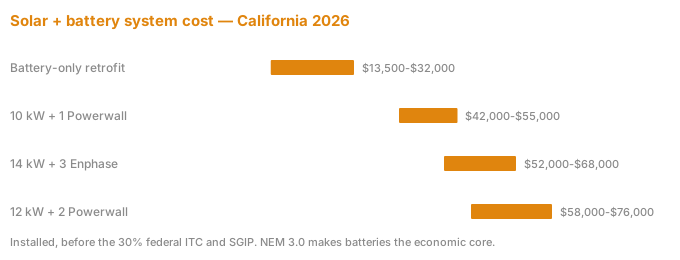
10 kW solar + 1x Tesla Powerwall 3 - $42,000-$55,000 installed
The mass-market California install. Gross cost before incentives.
12 kW solar + 2x Tesla Powerwall 3 - $58,000-$76,000 installed
Larger home, full or near-full backup capability.
14 kW solar + 3x Enphase IQ Battery 5P - $52,000-$68,000 installed
Microinverter-based architecture. Modular battery sizing.
Battery-only retrofit (existing solar owner) - $13,500-$32,000
Adding battery to an existing solar system. The fastest-growing segment in 2025-2026.
NEM 3.0 economics (why battery is now essential) #
Under NEM 2.0 (pre-April 2023), solar exports earned retail credit (roughly $0.30-$0.45/kWh). Under NEM 3.0, exports earn the much lower "Avoided Cost Calculator" rate (roughly $0.05-$0.08/kWh on average). This kills solar-only payback because daytime overproduction now barely offsets nighttime grid imports.
Battery storage solves this. Excess solar charges the battery during the day; the battery powers the home during high-rate evening hours (4-9 PM TOU peak). The household offsets imports at the high rate they would have paid, rather than exporting at the low rate the utility now credits.
Practical impact:
- Solar-only, NEM 3.0: 9-13 year payback. Marginal economics.
- Solar + 1 battery, NEM 3.0: 6-9 year payback. Reasonable.
- Solar + 2 batteries (full self-consumption): 7-10 year payback + backup power value.
- Battery-only retrofit, NEM 3.0 customer: 5-8 year payback.
California solar + battery incentive stack (2026) #
- Federal ITC (Investment Tax Credit) - 30% of system cost (solar + battery + install). Carries forward if not absorbed in year 1.
- SGIP (Self-Generation Incentive Program) - California-specific battery rebate. Standard tier: $150-$200/kWh. Equity tier (income-qualified): up to $1,000/kWh. Powerwall 3 in equity tier = up to $13,500 rebate.
- SGIP Heat Pump Water Heater bundle - additional incentives when paired with heat pump water heater.
- Property tax exclusion - California excludes solar / battery from added property tax assessment.
- Net cost example: $52,000 system gross - $15,600 ITC - $2,700 SGIP (standard) = $33,700 net.
What drives California solar cost variation #
System size (kW DC)
Bigger systems hit better $/W due to fixed soft costs (design, permitting, mobilization). 12 kW typically $0.20-$0.40/W cheaper than 6 kW.
Panel tier
Tier-1 Chinese (Jinko, JA Solar): cheapest. Premium American (Silfab, SunPower legacy): mid. Maxeon, REC Alpha Pure-R: premium tier.
Inverter architecture
String inverter (SolarEdge, Sungrow): cheaper. Microinverter (Enphase): higher cost, panel-level optimization, better in partial-shade scenarios. DC-optimized string (SolarEdge HD-Wave + optimizers): middle ground.
Roof type
Composition shingle: cheapest install. Tile: $0.30-$0.60/W more from extra labor + flashing. Standing seam metal: easiest (snap mounts), cheap. Foam / flat: needs ballasted racking or penetrations + flashing.
Service panel + main panel
Main panel must accommodate the inverter. Most California homes need a sub-panel or panel upgrade for systems over 7-8 kW. Adds $2,500-$8,500.
Trenching / EV charger bundle
Adding an EV charger or panel run during the same project saves mobilization cost.
City-by-city California solar + battery cost variation in 2026 #
Same 10 kW solar + 1 Tesla Powerwall 3 install, mid-tier equipment:
- Simi Valley, Moorpark, Camarillo: $38,000-$48,000
- Thousand Oaks, Calabasas: $42,000-$53,000
- San Fernando Valley: $40,000-$50,000
- Bay Area (Palo Alto, Saratoga): $46,000-$58,000
- Orange County (Irvine, Newport Beach): $43,000-$54,000
- San Diego County: $40,000-$51,000
How to get an accurate solar + battery quote #
- Get a production estimate, not just system size. A 10 kW system in Simi Valley produces differently than a 10 kW in San Francisco. Insist on a PVWatts or HelioScope-backed production estimate (annual kWh).
- Get the actual equipment model numbers. Brand, model, wattage per panel, inverter spec. Not just "10 kW system."
- Battery sizing analysis. A real proposal will model your hourly load profile vs solar production + battery dispatch under NEM 3.0 TOU rates. If the proposal is just "1 Powerwall," ask for the math.
- SGIP application processing. Reputable installers file SGIP for you. Confirm in writing.
- C-46 or C-10 license. California solar contractors must hold a C-46 (Solar) or C-10 (Electrical) classification. CSLB lookup.
- Avoid lease / PPA without doing the math. Cash or financed ownership almost always beats lease / PPA over the system lifetime. Run the numbers.
For solar installers: lead pricing context #
Solar + battery is high-ticket, longer-cycle. 2026 economics:
- Exclusive solar lead pricing: $80-$220 per inbound call
- Close rate: 10-20% (longer sales cycle, multiple bids common)
- Cost per closed job: $400-$1,800
- Average job ticket: $32,000-$58,000 (solar + battery); $13,500-$32,000 (battery-only)
- Marketing cost as % of revenue: 2-5%
If you're a California solar installer, our solar leads page covers exclusive market pricing. Or check open markets.